
Washington D.C.: where government meets knowledge
- 16 sep 2016
- 4 minuten om te lezen









Our latest trip in this country was to it's impressive capitol: Washington D.C. A bustling, modern and fast-paced city, where hardly anyone seems to take the time to sit and eat lunch. People grab to-go meals as if they were a free cup of coffee and are 'walking while texting' champions.
Besides being the seat of government, Washington also is the center of knowledge with over twenty free museums and multiple research institutions. Making it a city where it is almost impossible to get bored.
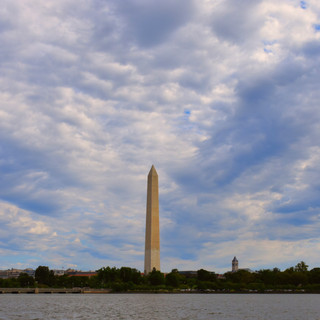
We spent most of our three days in D.C. around The National Mall, a strip of green with free museums of the Smithsonian Institute and many monuments. You can rent bikes with the 'Bike share' plan and bike around or put on your hiking shoes to walk the three kilometers from the Capitol on the far east side to the Lincoln Memorial in the west. The several monuments are spread out around the west part, starting with the Washington Monument, a 170 meters tall obelisk to commemorate the first US president George Washington. Out of the dozen war memorials, I found the Korean war veterans monument standing out as a particularly impressive one. The stretch of green shows 19 stainless steel statues of soldiers looking at you a bit frightend, representing a squad on patrol in Korea.
But the monument that everyone talks about and which stands tall at the far west side of the Mall is the Lincoln Memorial, a sort of Greek doric temple with a 20 meter high statue of Lincoln inside. I guess I am no fan of putting men on pedestals like that, but the site has become a symbolic venue for the Civil Rights movement and Martin Luther King Jr. delivered his famous speech on it's steps. The view from the monument is beautiful and that alone is worth a visit.
A nice walk around the nearby Tidal Basin leads you to the Roosevelt Memorial, which in my opinion is more appropriate and really nicely done.
Further along the path is the Jefferson Memorial. This also resembles a Roman temple with a statue inside (a man on a pedestal again), but is more modest and in a way gives the Tidal Basin a slight romantic feel.
Anyway, enough said about the monuments on the Mall, better are the Smithsonian Institute's museums. The Smithsonian was established in 1846 by the US government after receiving a large sum of money left by James Smithson's nephew. Meant to 'increase and diffuse knowledge', the Institute became a research center as well as a depository for the various government collections. Now it consists of nineteen museums, nine research centers and a zoo, and all are free to the public. With the humid and hot summers in Washington, these are the perfect places to spend your days (but don't forget a jacket, the A/C's are working overtime)!
The National Museum of Natural History is the most famous (and most crowded) one of them all and is like a Zoo of real stuffed animals and has over 126 million specimen in it's collection. We loved the Mammals section and the part about the Mummy's definitely deserved more space. Try not to visit on weekends, though, unless you like to be hit by strollers all the time.
Another great museum on the Mall is The National museum of American History. It shows famous battles in US history, the dresses worn by all the first ladies (yes, very important indeed) and the original Star Spangled Banner flag.
The last one we visited was the National Air and Space Museum. To me this was a surprisingly fun museum to visit. It is not just old planes that hang from it's ceiling but they also give a lot of information about the history of navigation, space missions and our planets in general. They also have several theaters were they show impressive 3D films. We watched 'A beautiful planet' with great footage of our earth filmed by ISS crews.
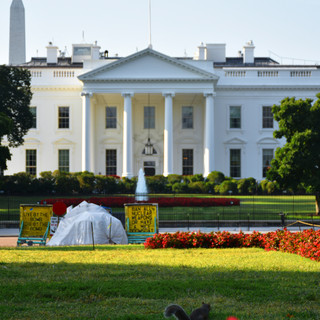
While visiting all these museums and monuments, you almost forget that this city is the seat of the US government. So another must-do is obviously walking past the famous White House, the official residence of the President of the United States. It surprised me that it really resembles a 'normal', though oversized, house and you can get relatively close to it. It is also possible to take a tour inside, but you have to book this months in advance.
Our last stop before flying back to the desert was another government icon: the US Capitol. The only way to get inside is by a guided tour. They say you have to book in advance, but when we got there they still had plenty of tickets to give away. The tours are not small, so you get headphones to listen to the guide and as a pack of sheep you are guided through the old meeting rooms, the beautiful Rotunda and the crypt. You can also get a pass to watch Senate and the House of Representatives in session from the galleries. Very interesting to see up close, but when we took a seat to watch the Senate in session there were only two senators present. Apparently this is a normal thing, but it gives outsiders the idea that nobody is working...
After seeing the government 'in action' it was time for us to get back to Arizona. Back to a place where people do take the time to sit and eat their burrito's, but where the most impressive building is an old mission church...
Opmerkingen