
Utah: Red Rocks, Arches and Canyons
- 10 jun 2017
- 6 minuten om te lezen









































It's been more than a month, so time for another road trip! While we usually focus our trips on and around bigger cities, we this time headed out to visit some of the most famous national parks of the country. The United States has a total of 59 protected areas know as national parks, and our neighboring state Utah has 5 of them. All located on a 2-hour drive or less from each other, this part of the US is a favorite among tourists for a reason.
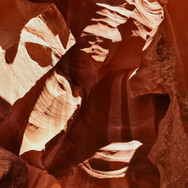
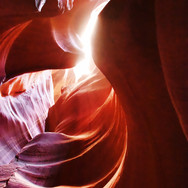
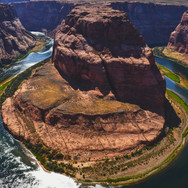
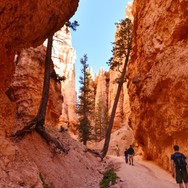
The first stop on our way to the North was the town Page, famous for the rock formation called 'Horseshoe Bend' and the recently (by tourism) discovered 'Antelope Canyon'. This narrow, red canyon is exploited by the Navajo Indians, who always ask just a little more money than the State. Still, it is definitely worth it. As a tourist you can either visit 'Upper' or 'Lower' Antelope, and we opted for the first one. Only reachable by a tour, you have no other choice than pay the hefty fees and step into one of their trucks. The tours work on a first come, first serve basis, so our guide went all Mad Max and literally raced through the desert to get our group there first. We were lucky to 'win' and enter the, still quiet, canyon by ourselves. She led us through the small ravine, while pretending to be a photographer and stealing everyone's iPhone to take pictures the whole time. And while talking Chinese to every Asian looking person that passed us. I can tell you, they looked annoyed...
The canyon itself is beautiful, if you are able to ignore all the people in the small space that forms Upper Antelope (the trick is to look up!!). Photographers should visit between 11 and 13 for the famous light beams, and of course we were lucky to get a spot at two o'clock. Still, plenty of photo opportunities to test our iPhone and Nikon skills. On our way back to the truck the guide also told us, matter-of-factly, that snakes always fall down from the canyon walls in the morning. I am so glad I didn't know that when entering. But luckily, you do.
After our visit to Page, we left Arizona to go to our first National park of the week: Zion.
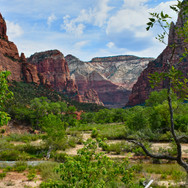
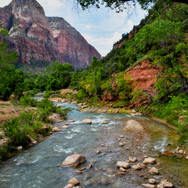
With nearly 3 million visitors a year, this is the most crowded park of the 'big five'. Arriving early is therefor a must. We entered through the East entrance that leads to the Canyon Scenic Byway, a red road that shows you a first glimpse of the magnificence of Zion. As an orientation, we walked the Canyon Overlook trail to get amazing views of the different rock formations. Unfortunately, walking the trail meant we arrived at the Visitor Centre after 8 in the morning, which means: crowds. Zion doesn't allow you to drive through the park yourself, so you are forced to park your car somewhere near the Centre (when you're lucky), or in nearby Springdale, and then take a shuttlebus. And even though the lines were more like that of Disneyland, it moved much faster and waiting wasn't too bad.
What was bad, though, was the number of hikers on an average trail. It made Zion one of the most beautiful, but also one of the most difficult parks to enjoy.
Besides busses full of Chinese and elderly people, there is also another crowd visible in Utah. The religious background of the State is certainly noticeable. Not only did we see a lot of long dark dresses walking around at Walmart, they also didn't sell alcohol stronger than 3.2%, much to our disappointment. Ever tried Corona's that are even lighter than 'light'...?
One of our overnight stays was in the middle of nowhere, close to Bryce Canyon national park. A man from Colorado was debating these alcohol laws with the waitress of our motel bar while drinking Coors light. By Utah law he wasn't allowed to order another beer (for his friend) without finishing first, nor was he allowed to drink without any food with it. I agree, that is weird, but Coors light isn't beer. Period.
After finishing our Corona lemonades we made our way to the next park: Bryce Canyon.
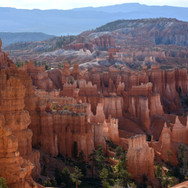
This park has a 14-mile scenic drive with a lot of lookouts over the several Canyons it exists of. And even though the view from the most Southern point is beautiful, the most impressive part of Bryce is the 'Amphitheater'. So-called 'hoodoos' are visible as far as the eye can see, and they turn bright red in the morning, lighting up as candles. The only way to truly see the magnificence of these rock formations is to go for a hike. And even thought the weather is relatively mild in this area, you do want to start early to beat the crowds. And to have the best light to test your camera skills. Yes, do not, and I repeat, do not forget your camera when you go to Utah!
Talking about cameras, there actually is a State park close-by named after Kodak Film: the Kodachrome Basin State Park. When National Geographic visited and photographed the area in 1948 they thought it was so beautiful and photogenic that they named if after the film they used in their cameras. With Kodak's permission, the name remained and you can now see for yourself.
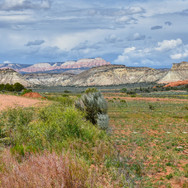
If you want peace and quiet, this is the place to be. As long as it stays undiscovered by the masses, that is. Contrasting red and whites line the horizon, giving it an almost sic-fi-like feel. To get the best views of the small park and surroundings, walk the Angels Palace Trail.
Another surprisingly beautiful, and relatively unknown, park is Capitol Reef.
I'd never heard of this park before visiting it. And I seriously don't know why, because it ended up being one of my favorites. Red rock formations everywhere, more impressive than anywhere else. The park comes into view after driving on Highway 12 from the town of Escalante. And even though it certainly has beautiful lookouts along the way, we mostly enjoyed a surprisingly good coffeehouse that appeared in the middle of nowhere, the KIVA coffeehouse. If you want coffee with your view, this is the place to be!
Capitol Reef is big, but only a small part of it can be visited by driving a paved scenic byway. So this was the first time we realized we should've rented an SUV, and not a city-friendly Nissan Versa. I mean, the car was great. It just didn't have power to drive up the hill without an effort (I stopped breathing every time the road became steep). The last part of the Capitol Reef scenic road is the unpaved Capitol Gorge, which we were thus unable to drive. We almost did. But getting stuck in a gorge just doesn't seem smart.
An SUV is also a good idea when visiting Canyonlands National Park. 80% of this park is unpaved, rough terrain. It is hard to define the park when only driving on the scenic drive. Canyons and impressive rock formations are visible all around you, but are all so far away. And we had already seen so many up close! Yes, you get spoiled...
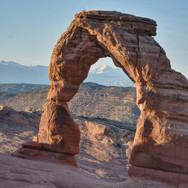
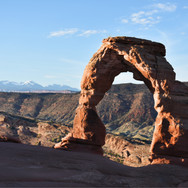
We therefor quickly went on to our last park of the trip: Arches. It really is all in the name, it has arches. For some reason the highest density in the world (same for old people by the way). We got up early for the last time (did I mention this was a road trip, not a vacation?) and hiked the strenuous but beautiful 'Delicate Arch' trail. The views at the end of the trail were absolutely worth getting up for before the break of dawn, and when our loud fellow countrymen started arriving too, we slowly made our way down to the car.
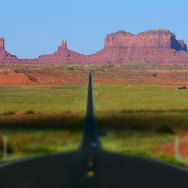
On our way South from Arches we drove past the famous formations of Monument Valley, which are most impressive coming from highway 163. Unfortunately we weren't able to drive the scenic road into the park (one word: SUV), but by now we were done with rock formations and scenic roads anyway. It was time to go back to civilization and plan a trip to a city.
Next stop: Vancouver!
Opmerkingen